
Transylvania County Court Records After Arrest
After a Transylvania County jail arrest, the jail roster is only the custody side of the event. It can show booking charges, arresting agency, bond, booked date, and a current custody card. The court record begins when process is filed and the criminal case is opened or updated through the North Carolina Judicial Branch. That case can show the formal charge wording, case number, hearing dates, amended charges, indictment activity, pleas, dismissals, convictions, and other dispositions.
The arrest-to-court path is important because the first jail label may not match the final charge. A roster card can list a procedural label such as a true bill of indictment, federal detainee, or local charge. The prosecutor and court system may later file, amend, reduce, dismiss, or supersede a count. For custody and booking data, use Transylvania County jail inmate records. For booking photos, use the Transylvania County jail mugshots page. For court records after a jail arrest, use eCourts, the clerk, and public terminal access.
Find Court Records After Arrest
The main online court channel is the North Carolina eCourts Portal. The Portal supports Smart Search for court records and case information, Search Hearings for court dates, payments for some matters, and judgment search. The Judicial Branch court-records help page also says criminal case information can be accessed from a public self-service terminal at a clerk's office in any county, with searches by defendant name, case number, or victim and witness name where available.
- Start with the jail roster to collect the person's name, booking date, arresting agency, and booking charge label.
- Open eCourts Portal and use Smart Search by name or case number if known.
- Use Search Hearings when the immediate need is the next court date.
- Visit or contact the Transylvania County Clerk of Superior Court if the Portal does not show the case or if paper-file access is needed.
- Compare the jail charge label with the formal court charge, case status, hearing events, and disposition.
The captured North Carolina eCourts Portal landing page shows the Smart Search and hearing-search modules used for court records after a Transylvania County arrest.
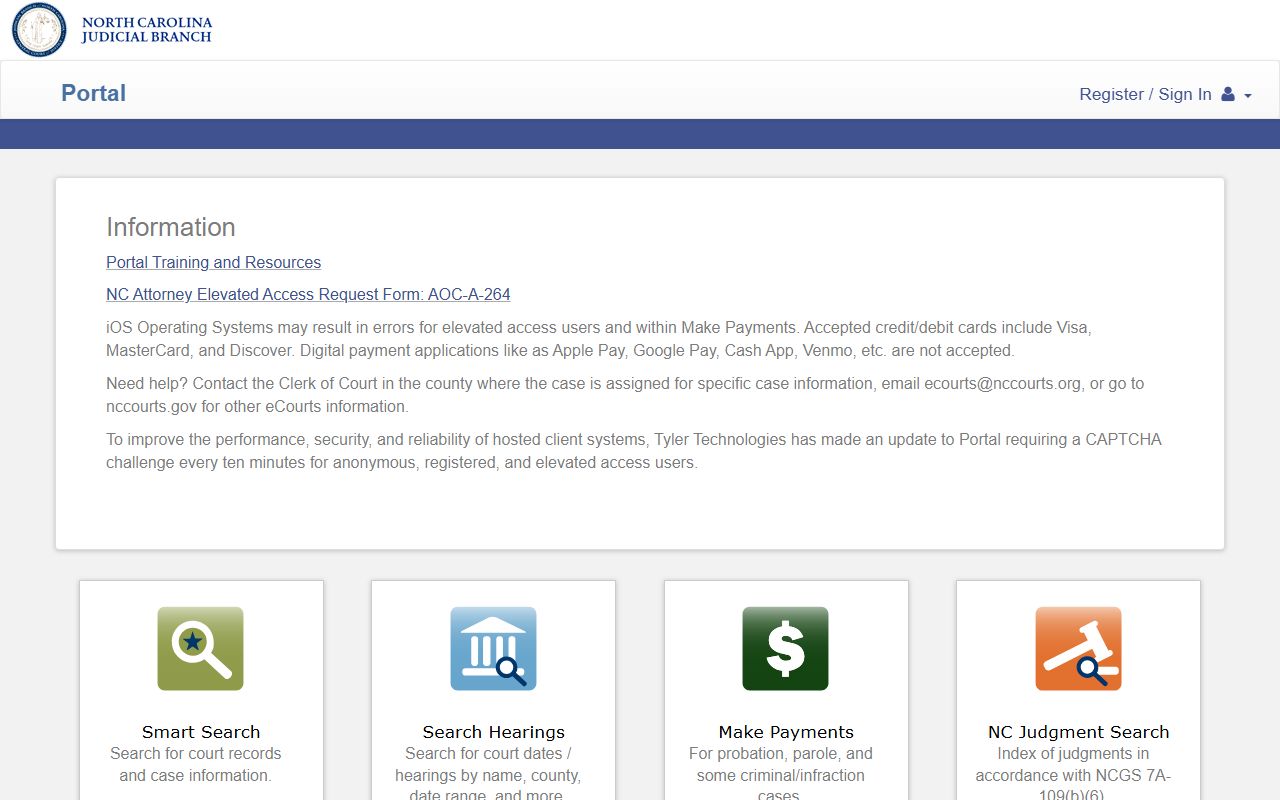
The Portal is a court search tool, so it should be paired with jail data rather than treated as a booking-photo or custody roster.
Transylvania County Court Search Fields
eCourts Portal controls differ from the jail roster. The Portal is built for case information, hearings, payments, judgments, and account access. Anonymous, registered, and elevated users can face CAPTCHA checks. The Judicial Branch also warns that people doing background checks should use the county clerk's office rather than assuming Portal output is a certified background check.
| Portal Feature | Type | Required | Notes |
|---|---|---|---|
| Smart Search | Search module | No | Searches court records and case information. |
| Search Hearings | Search module | No | Finds court dates and hearings by name, county, date range, and related fields. |
| Make Payments | Module | No | Supports payments for some criminal, infraction, probation, or parole matters. |
| NC Judgment Search | Module | No | Judgment index under North Carolina court law. |
| Register / Sign In | Account controls | No | Portal supports anonymous and account-based access levels. |
| CAPTCHA | System control | Recurring | Portal notice says Tyler requires CAPTCHA every ten minutes. |
Charges Filed After Arrest
Charges after a Transylvania County arrest may begin in District Court or move toward Superior Court, depending on the offense and procedure. Misdemeanors commonly proceed in District Court. Felonies may involve first appearances, probable cause stages, grand jury action, indictment, information, plea, or trial stages. The District Attorney for Prosecutorial District 42 handles state prosecutions for Henderson, Transylvania, and Polk counties, while federal matters use federal court channels.
| Document | Who Uses It | What It Does |
|---|---|---|
| Complaint | Officer, magistrate, or prosecutor process | Begins or supports a criminal charge and states the alleged offense facts. |
| Information | Prosecutor | Files formal charge language without a grand jury indictment where procedure allows. |
| Indictment | Grand jury | A true bill means the grand jury returned an indictment for Superior Court prosecution. |
North Carolina public-records law treats returned warrants, indictments, criminal summons, and certain other returned process as public court records unless sealed. That does not make every police report or investigative file public, because criminal-investigation records have separate limits under N.C.G.S. 132-1.4.
Charge Status After Arrest
A charge status is not the same thing as custody status. A person can be released while charges remain pending, held on a detainer after local bond is met, or transferred after a sentence while the court record remains public. The jail roster may show a bond total and booking charges, but eCourts and clerk records are the better sources for formal case status.
| Status | Meaning in Court Records |
|---|---|
| Pending | The charge has not reached final disposition. |
| Amended | The charge wording, level, or count has changed from an earlier version. |
| Reduced | The charge was lowered to a lesser offense or lesser level. |
| Dismissed | The charge was ended without a conviction on that count. |
| Convicted | The charge resulted in a guilty plea, verdict, or other conviction entry. |
| True bill | A grand jury returned an indictment, which can later appear in jail and court records. |
Transylvania County Court Contacts
The Transylvania County Courthouse is separate from the Public Safety Way detention center. Custody and booking records sit with the sheriff and jail. Formal court files and clerk access sit at the courthouse. The county courthouse page identifies the historic courthouse at 7 E. Main Street in Brevard, while the Judicial Branch county page and contact directory route clerk, magistrate, district attorney, and judge contacts.
Transylvania County Clerk of Superior Court
7 E. Main Street
Brevard, NC 28712
828-885-3000
Use for court case access, public terminals, and file questions.
District Attorney, District 42
Transylvania County Courthouse
Brevard, NC 28712
828-885-3010
Prosecution office routing, not private legal advice.
Magistrates
Transylvania County court system
Brevard, NC
828-884-3154
Initial process and bond-related routing.
Bond Records After Arrest
Bond information can appear in both jail and court contexts. The Transylvania County roster showed bond total and per-charge secured bond details on some sample cards. After arrest, a magistrate or judge sets release conditions such as written promise, custody release, unsecured bond, secured bond, cash deposit, or no-bond and hold situations. The jail can confirm the current release condition, accepted payment method, and whether another hold prevents release.
| Bond Type | How It Works |
|---|---|
| Written promise | Release based on a promise to appear in court. |
| Unsecured bond | No upfront payment, but money may be owed if conditions are violated. |
| Secured bond | Requires cash, security, or a bondsman before release. |
| Cash deposit | A cash payment is required under the release condition. |
| No-bond or hold | Release may be blocked by the court, another agency, federal custody, immigration, probation, parole, or outside-county process. |
Warrants and Arrest Records
No standalone official Transylvania County active-warrant list was found in the research. Citizen Connect does include a Criminal Papers Search, and the sheriff's office serves court papers as part of its function. Use that public search where available, then call to confirm any warrant question. A person with an active warrant may be arrested if they appear in person, so warrant questions can have immediate custody consequences.
Warrants can lead to booking records. Arrest warrants, orders for arrest, true bills of indictment, fugitive holds, extradition matters, federal warrants, and U.S. Marshals holds may appear as custody labels or arresting-agency entries. Returned warrants and indictments may become public court records unless sealed, but search warrants and investigative materials are not the same as jail inmate records.
Charges Versus Convictions
A Transylvania County arrest or charge is an accusation or custody event. A conviction is the result of a guilty plea, verdict, or other final judgment on a count. This distinction matters for court records after a jail arrest because a reader may see a jail charge, a pending case, a dismissed count, and a conviction in different systems at different times.
| Issue | Charge | Conviction |
|---|---|---|
| Stage | Filed or alleged offense after arrest. | Final result after plea, verdict, or judgment. |
| Proof | Based on probable cause or formal accusation. | Requires guilty plea, verdict, or court entry. |
| Roster Link | May first appear as a booking charge. | Does not appear simply because a person was booked. |
| Record Source | Jail roster and court filing can both show it. | Clerk and court records are the controlling source. |
Sealed and Expunged Records
North Carolina expunction law can remove qualifying records from public access after a court order, including certain dismissed, not-guilty, and nonviolent conviction records. Sealing and expunction are court processes. The jail, court, state repositories, and third-party copies may not update at the same time, so a person should use the court order and the originating record custodian for any specific correction or removal request.
| Issue | Sealed | Expunged |
|---|---|---|
| Public view | Hidden or restricted from ordinary public access. | Removed from public access under the court order. |
| Process | Requires legal authority or court action. | Requires eligibility and a court order under North Carolina law. |
| Agency records | May still exist in restricted systems. | Custodians update records according to the order. |
| Best source | Clerk or attorney. | Clerk, court order, and record custodian. |
Restricted Arrest Court Records
Some court records after a jail arrest may be hard to find because access is legally limited, not because no case exists. Juvenile matters, sealed files, confidential identifiers, medical information, some victim information, and criminal-investigation records can be withheld or restricted. N.C.G.S. 132-1.4 is especially important because it separates public arrest information and returned process from nonpublic criminal investigation and intelligence records.
Important: Casual court searches are not FCRA consumer reports and should not be used for employment, credit, tenant, insurance, or similar decisions.
For a certified or background-check use, follow the Judicial Branch and clerk process rather than relying on a web search. For legal advice, record-clearing strategy, or warrant response, contact a licensed attorney. Court staff and prosecutors can route records questions, but they do not give private legal advice.